

FAERO TECHNOLOGY
THE TECHNICAL PROBLEM
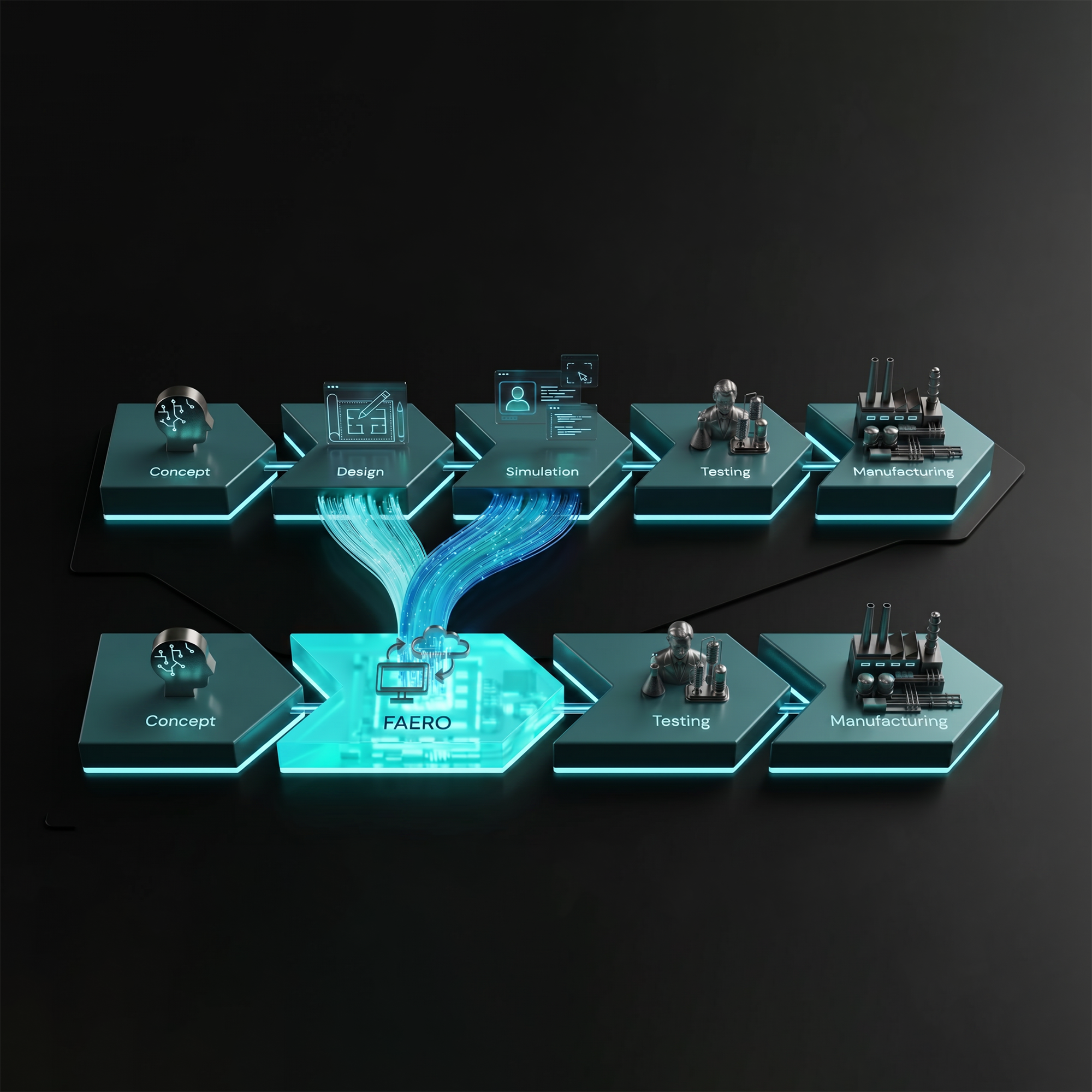
As aerospace systems become increasingly advanced, their development is also becoming more complex. Yet the engineering process remains largely unchanged. In particular, design and simulation workflows remains inefficient. Despite accounting for up to 40% of total development costs and timelines, engineering teams still struggle significant challenges, including:


THE INNOVATIVE SOLUTION
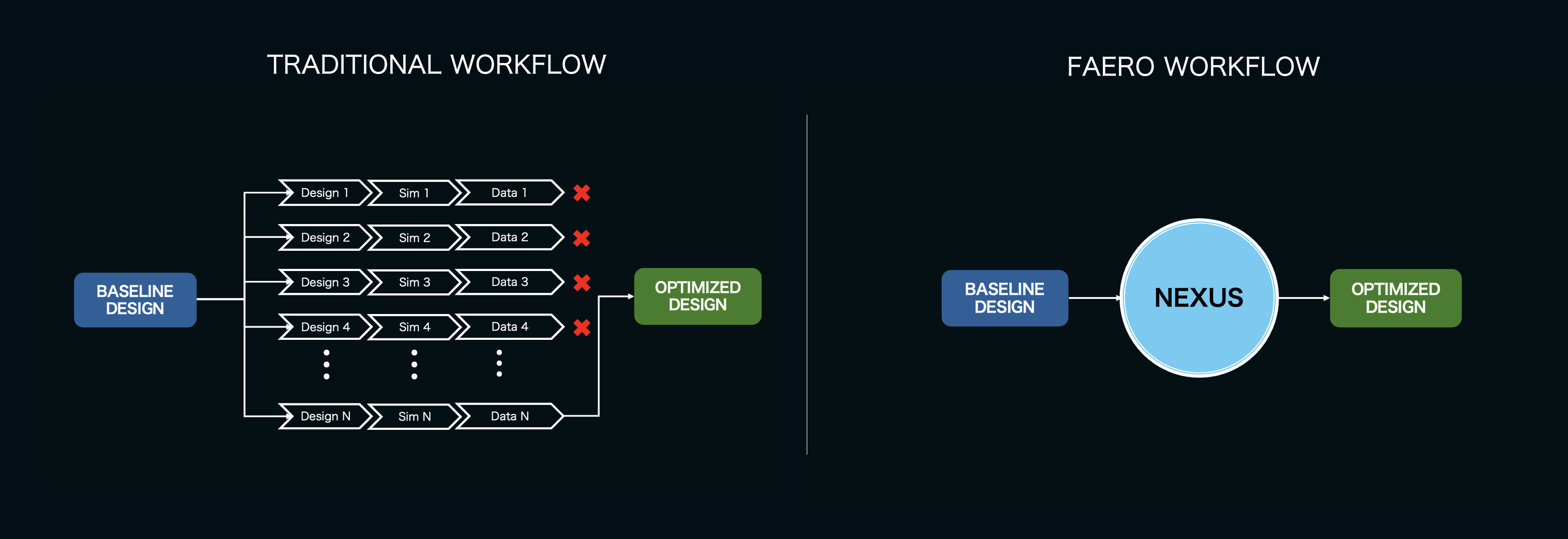
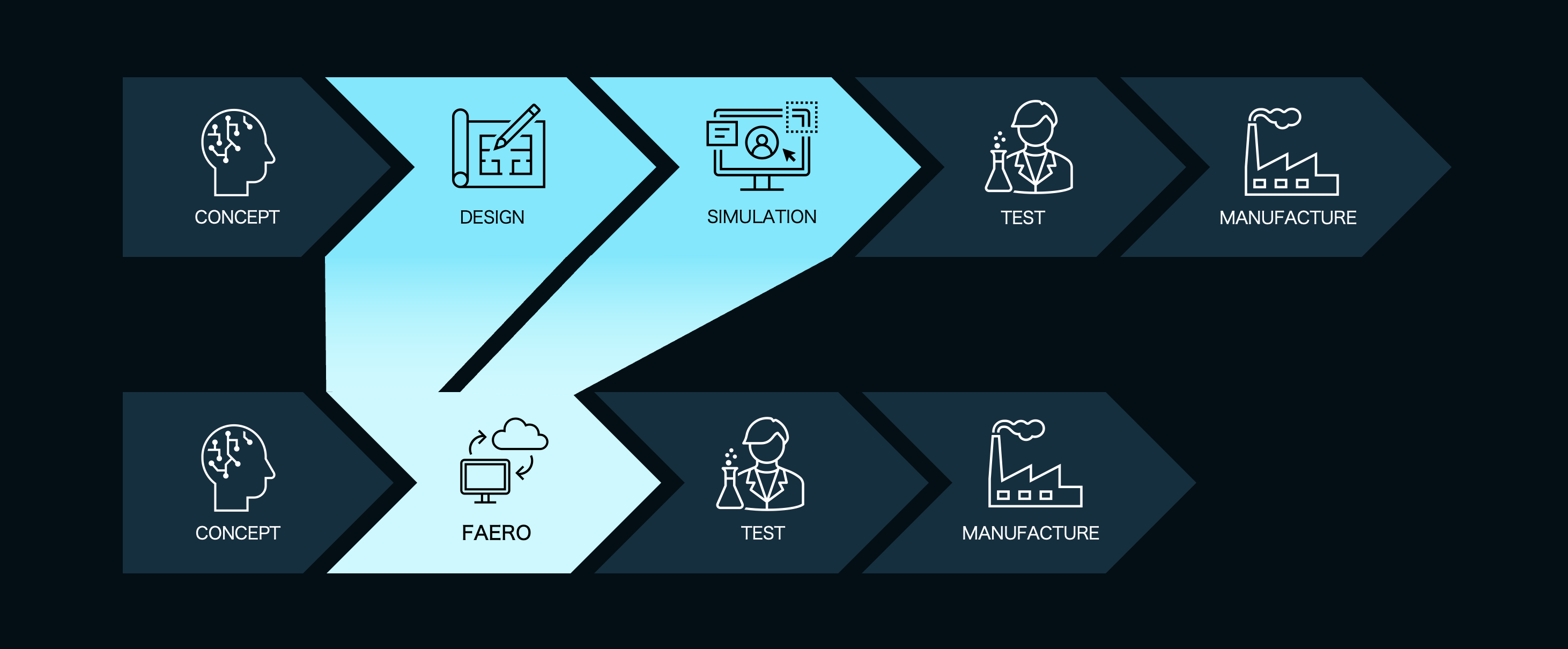
To address the challenges above, FAERO integrates design and simulation workflows into one unified opitmization platform, NEXUS platform. The NEXUS enables more efficient aerospace system development, reducing total costs and timelines by up to 25%, while advancing innovation.
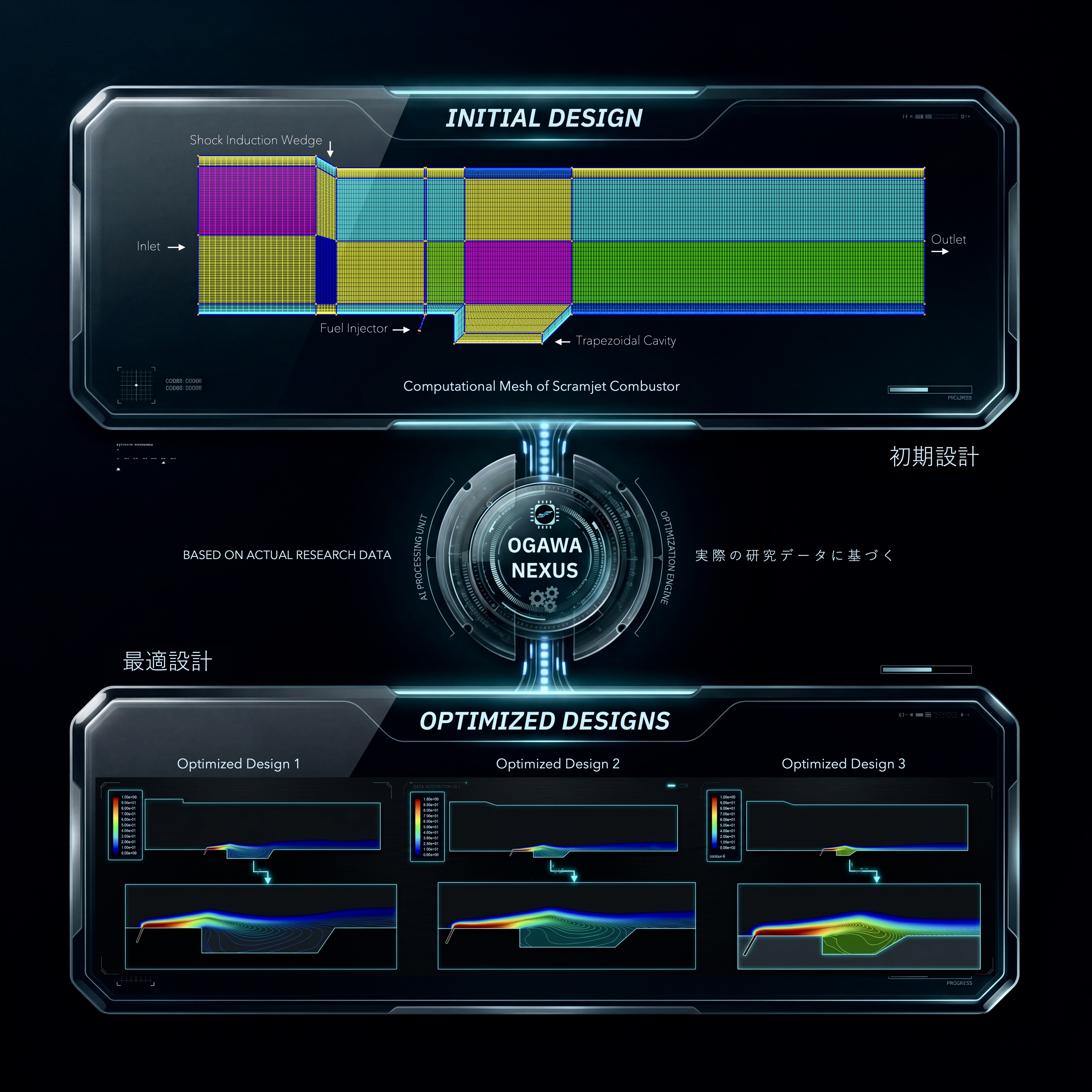
It delivers value across three key areas of aerospace development: design exploration, simulation, and optimization. In an automated workflow, NEXUS can explore over 1,000 design variations from a single baseline design. Additionally, it significantly accelerates CFD simulations through its advanced metamodeling capabilities. Finally, it automatically generates optimized designs based on user-defined objectives and constraints.
Additionally, the platform is designed for seamless industry integration. It is compatible with leading computational solvers, including ANSYS Fluent and OpenFOAM. Once users define the design parameters and solver setup, the optimization workflow can be initiated with a single click of the Run button.
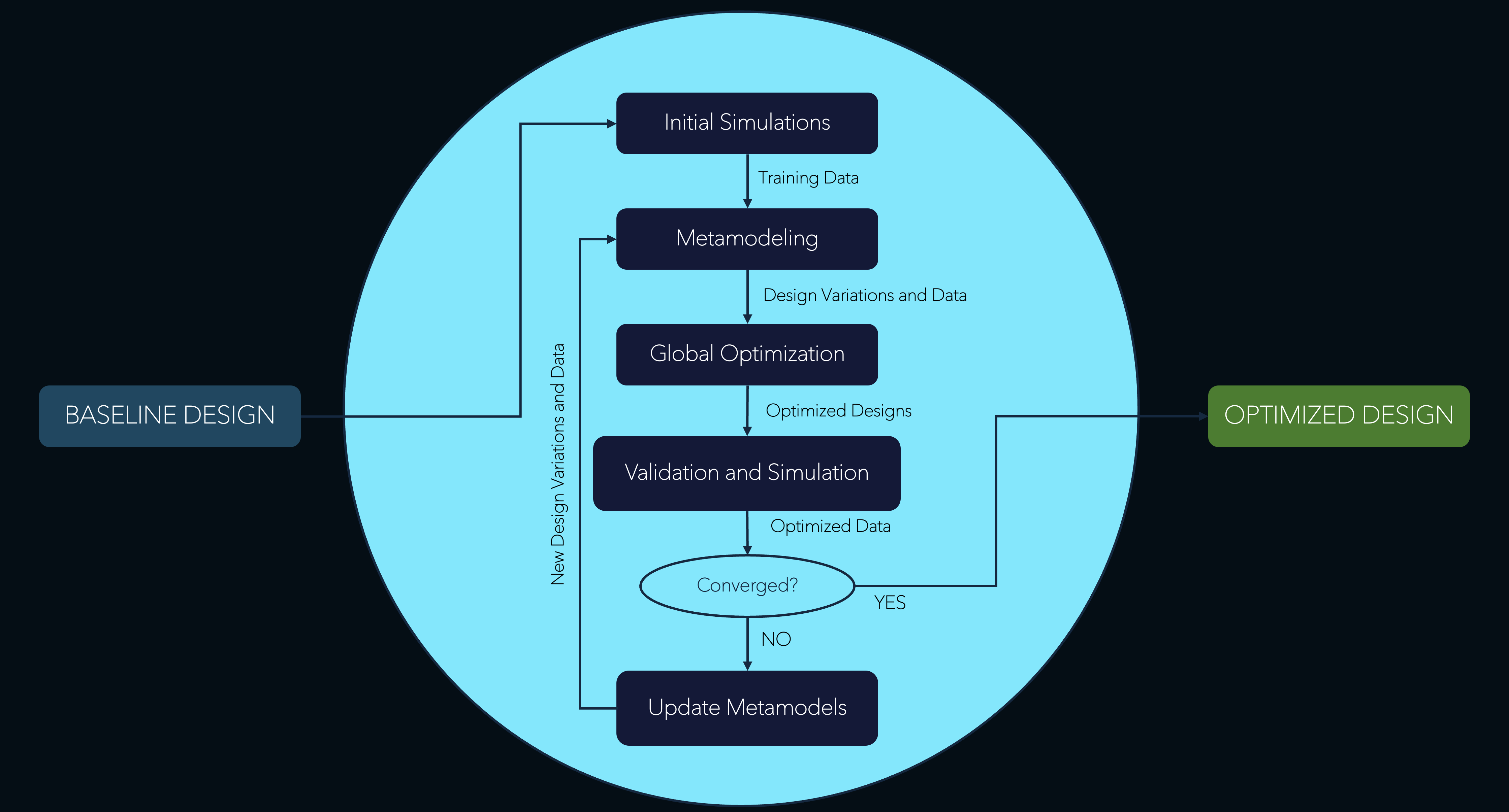
NEXUS operates through an automated six-step iterative optimization process:
- Design Definition: Users define the design parameters and solver setup
- Initial Simulations: Initial simulations generate training datasets
- Metamodeling: Deep learning models approximate simulation results
- Global Optimization: Optimization searches the best solutions in the design space
- Validation: High-fidelity simulations validate optimized solutions
- Evaluation: Engineers select the best-performing designs
In summary, the NEXUS is a next-generation optimization platform that enables users to:



TECHNICAL PROOF
The ON platform was developed and applied through aerospace engineering research at Kyushu University, Japan, and its technical accuracy has been validated through peer-reviewed scientific publications. The following are a few publications where the ON is applied.
- Ogawa, H., et al. “Nozzle Design Optimization for Axisymmetric Scramjets by Using Surrogate-Assisted Evolutionary Algorithms.” Journal of Propulsion and Power, Vol. 28, No. 6, 2012, pp. 1266–1278. https://doi.org/10.2514/1.B34482
- Ogawa, H., et al. “Numerical Investigation of Upstream Fuel Injection through Various Injector Geometries in a Supersonic Crossflow.” AIAA SciTech Forum, AIAA Paper 2021 1960, 2021. https://doi.org/10.2514/6.2021-1960
- Ogawa, H., et al. “Numerical Investigation of Upstream Fuel Injection through Various Injector Geometries in a Supersonic Crossflow.” 53rd AIAA Aerospace Sciences Meeting, AIAA Paper 2015-0884, 2015. https://doi.org/10.2514/6.2015-0884
- Ogawa, H., et al. “Physical Insight into Scramjet Inlet Behavior via Multi-Objective Design Optimization.” AIAA Journal, Vol. 50, No. 8, 2012, pp. 1773–1783. https://doi.org/10.2514/1.J051644
TECHNICAL PROOF
The NEXUS platform was developed and applied through aerospace engineering research at Kyushu University, Japan, and its technical accuracy has been validated through peer-reviewed scientific publications. The following are a few publications where the NEXUS is applied.
- H. Ogawa, "Mixing characteristics of inclined fuel injection via various geometries for upstream-fuel-injected scramjets", J. Propuls. Power 31 (6) (2015) 1551–1566.https://doi.org/10.2514/1.B35581.
- Ogawa, H., et al. “Numerical Investigation of Upstream Fuel Injection through Various Injector Geometries in a Supersonic Crossflow.” AIAA SciTech Forum, AIAA Paper 2021 1960, 2021. https://doi.org/10.2514/6.2021-1960
- S. Brahmachary, C. Fujio, H. Ogawa, "Multi-point design optimization of a high-performance intake for scramjet-powered ascent flight", Aerosp. Sci. Technol. 107(2020) 106362. https://doi.org/10.1016/j.ast.2020.106362.
- H. Ogawa, R.R. Boyce, "Nozzle design optimization for axisymmetric scramjets byusing surrogate-assisted evolutionary algorithms", J. Propuls. Power 28 (6) (2012)1324–1338. https://doi.org/10.2514/1.B34482.
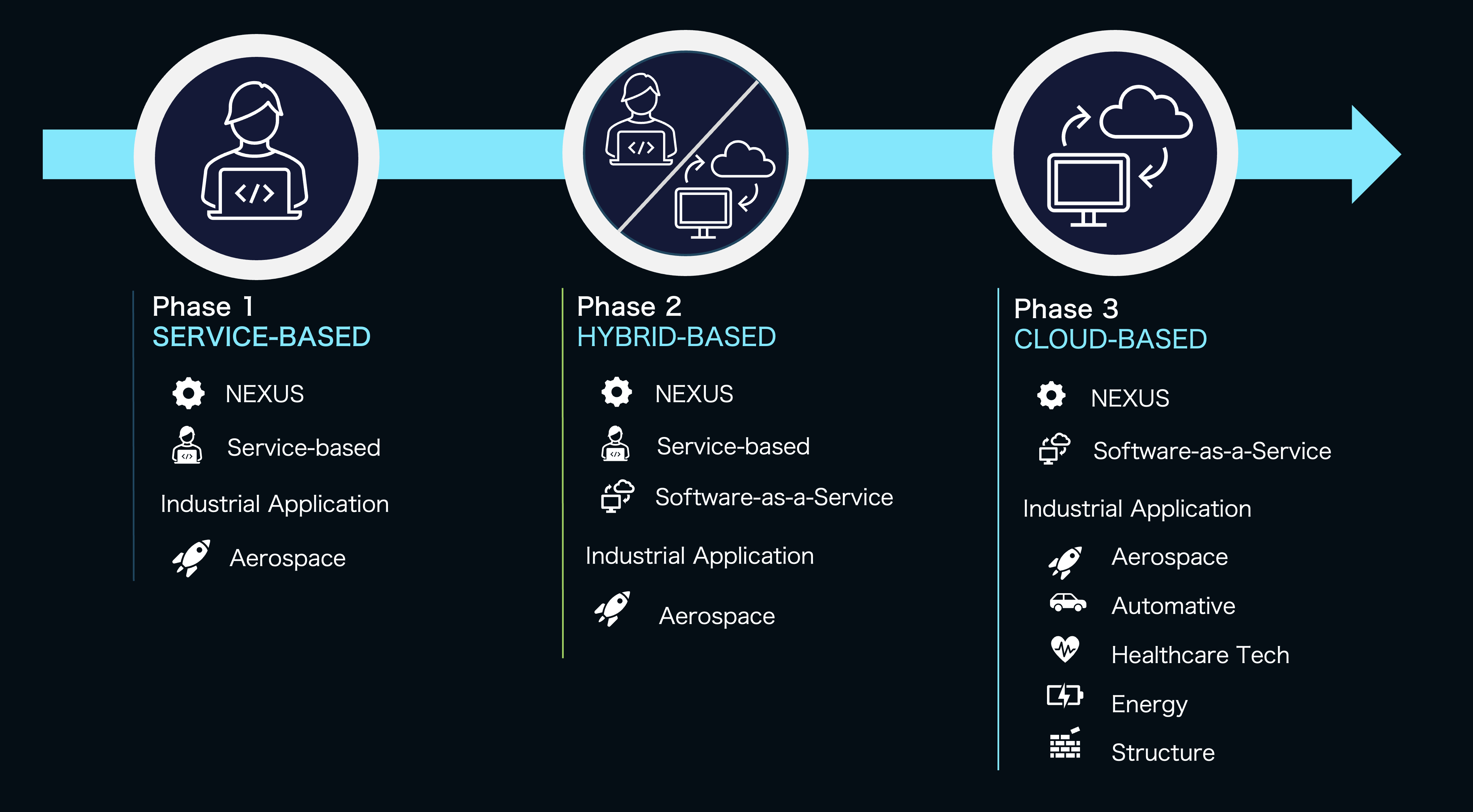
TECHNICAL ROADMAP